

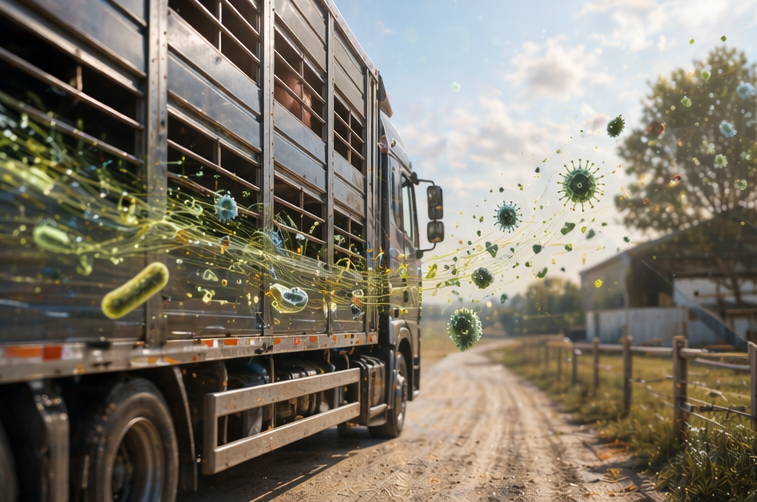

The Trojan Horse of Disease for Piggeries: Transport Trucks
For pig producers, biosecurity conversations usually centre on animal movement, herd health, staff hygiene, visitor control, and shed management. All of that matters. But one of the most underestimated disease risks in the system may be parked right outside the gate: the transport truck.
A truck is more than a logistics tool. It is a moving interface between farms, loading ramps, wash bays, drivers, equipment, and pigs of varying health status. With every movement comes the potential to pick up and carry contamination, often without any obvious visual warning. By the time disease appears on-farm, the real introduction point may already be behind you.
Where the Risk Really Sits
When people think about transport biosecurity, the focus often lands on whether a truck has been washed. That matters, of course, but the real risk is broader than the trailer floor alone.
It sits across the full transport interface: loading areas, driver movement, equipment, boots, washdown quality, and the line between the outside environment and the piggery itself. A truck may look clean while still carrying biosecurity pressure that is not immediately visible.
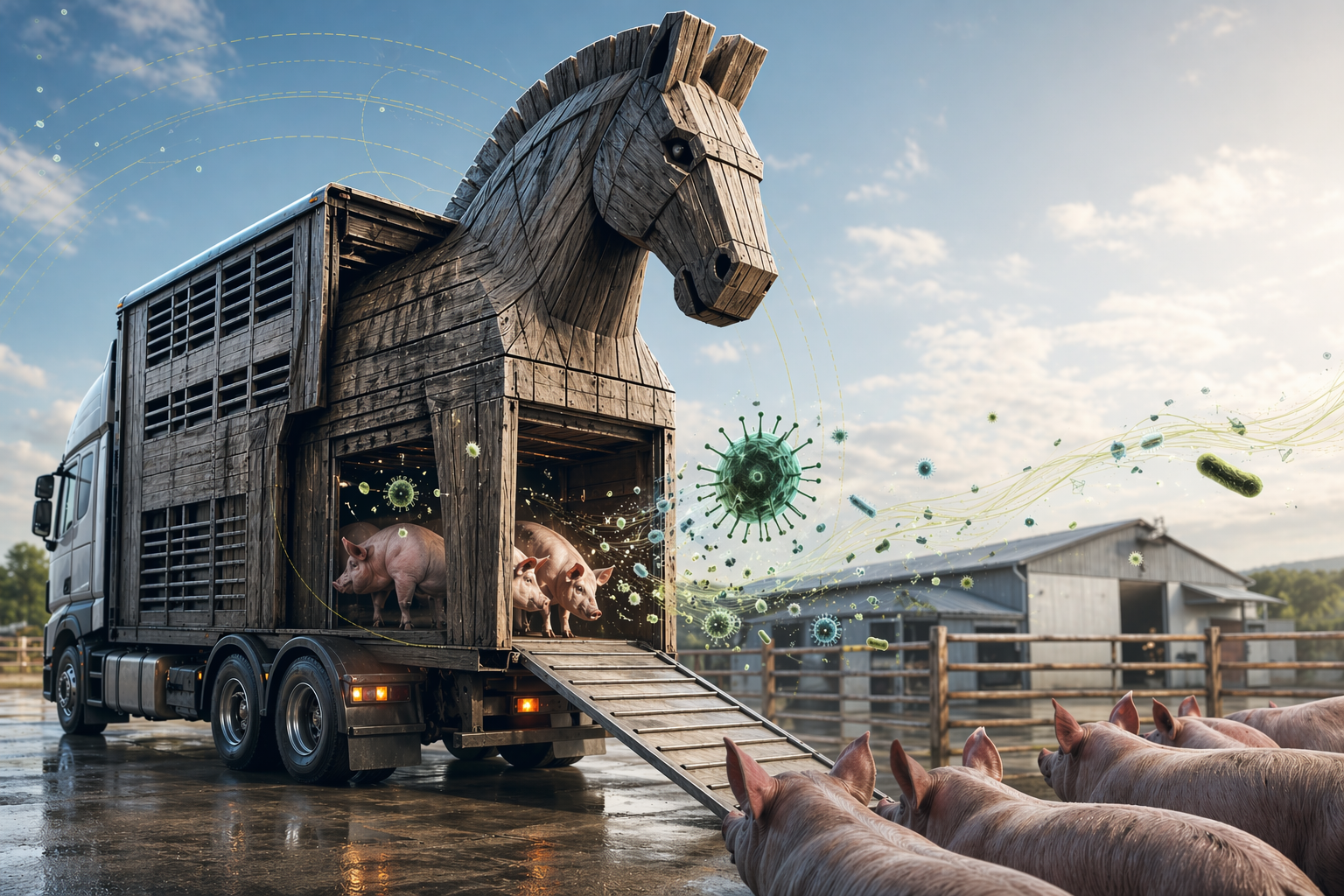
The Visibility Gap
That is what makes transport such a difficult challenge. Unlike a clinical issue in a shed, truck-related risk does not always announce itself. It moves quietly through routine operations, which makes it easy to normalise and easy to miss.
This is where stronger surveillance has a role to play. If trucks are already moving through multiple sites and environments, they can also offer a practical way to monitor what may be circulating across those movements.
From Transport Risk to Surveillance Opportunity
James Seckold, CEO at Sentinl, says that is exactly what made the approach valuable for their team.
“We’ve added Genics Bioaerosol Sampling to our pig transport trucks as a practical, non-invasive way to capture an airborne snapshot during movements,” he says. “It’s a low-labour approach that supports stronger biosecurity decision-making without needing to handle animals.”
That shift matters. Rather than treating trucks only as a risk point, they can also be treated as a surveillance point — a place to gather environmental intelligence that helps producers and service providers move beyond assumption and toward evidence.

Why Practicality Matters
Of course, surveillance is only useful if it is practical enough to apply consistently in the real world.
As Seckold explains, “The biggest win is visibility and making frequent surveillance more feasible.”
That feasibility is important. In biosecurity, methods that are too disruptive, too expensive, or too difficult to repeat rarely become routine. But when surveillance is simple and scalable, it becomes far more useful as an ongoing management tool.
Transport trucks deserve more attention than they often receive. Not only as a biosecurity pressure point, but as a valuable place to monitor what may be moving through the system before it shows up somewhere more costly. Because sometimes, the most important biosecurity insight is not inside the shed at all. It is already on the truck.
Want to know more about Pork MultiPath™?
Get all the information you need and book a free consultation with Genics experts today.


